 |
| Ham Radio Wayback Machine | This Week’s Story |
| From a Cellar to the Moon: The Arthur Collins Story Nobody Tells |

Arthur Collins at his home station, around the time of the 1925 MacMillan Arctic expedition. Credit: Collins Aerospace Museum.
|
| You think you know this story. Not yet. |
| Picture a small crew of engineers in Cedar Rapids, Iowa, wrapping up a sixteen hour shift sometime in the late 1930s. They are tired, they are young and they have nowhere else they would rather be. So they grab a case of beer, a bag of hamburgers and a few .22 rifles, and they head out to the city dump to shoot rats until the sun comes up. |
| Now picture the summer of 1969. A man in a bulky white suit steps onto gray dust a quarter million miles from home and says the words the whole planet is waiting for. Those words travel back to Earth on equipment built by the same company those rat shooting engineers worked for. Built, in more than a few cases, by their own hands. |
| That is the distance Arthur Collins traveled. From a dump outside Cedar Rapids to the surface of the Moon. Nobody put that on a plaque. I am putting it in this newsletter. |
| The Boy Who Beat the Navy |
| Arthur Collins was born September 9, 1909 in Kingfisher, Oklahoma. His family moved to Cedar Rapids in 1916, and his father M.H. Collins, a mortgage banker who would later stitch together nearly 30,000 acres of Iowa farmland into one of the state’s first mechanized corporate farms, had money and was willing to spend it on his son’s strange hobby. Arthur got licensed at fourteen. His father bought him vacuum tubes that most grown men in the hobby could not justify. |
| It paid off faster than anyone expected. In 1925, at fifteen years old, Arthur Collins was the only operator in the country who could keep a steady radio link with Donald MacMillan’s Arctic expedition in Greenland. The United States Navy tried and failed, working with longer wavelengths that could not punch through. A teenager working shortwave out of his family home in Iowa succeeded where the Navy did not. When messages came through, Arthur biked them across town to the Western Union office so they could be relayed to Washington. |
| Word got around. Admiral Richard Byrd remembered the kid from the Arctic story, and when he needed reliable radio for his 1933-34 Antarctic expedition, he came looking for Arthur Collins. By then Arthur had already dropped out of Amherst College, deciding that self-education and a soldering iron would take him further than a lecture hall. He was right. He never did finish college, not even after his name was on a Fortune 500 company. |
| There is a smaller story from those teenage years I like almost as much as the Arctic one. A local police officer named Henry Nemec was a radio enthusiast, and he took to parking his squad car outside the Collins house on a regular basis just to talk radio with Arthur and the other young operators who gathered there. The neighbors drew the obvious conclusion. They spent years convinced that young Arthur Collins was constantly in some kind of trouble with the law. He was just talking about antennas. |
| A Company Built in a Basement, Nearly Killed by a Lawsuit |
| Arthur married Peg Van Dyke in 1930, and in 1933 he started Collins Radio in their basement with four transmitter models. It should have ended a few years later. RCA came after him with a lawsuit claiming the vacuum tube oscillator patents behind his transmitters, patents that traced back to Lee de Forest, belonged to them. A judgment against Collins Radio at that stage could have finished the company before it built a single military radio. |

The Collins oscillator tube built on Robert Goddard’s 1912 patent. Gift of Mrs. Robert H. Goddard, Smithsonian National Air and Space Museum.
|
| Here is where the story gets strange in the best possible way. Arthur went digging through patent history and found something everyone else had missed. A vacuum tube oscillator patent filed in 1912, years ahead of de Forest’s work, by a man named Robert H. Goddard. Yes, that Goddard, the same man who would later be called the father of American rocketry. Collins reached out, Goddard agreed to help, and in 1938 the lawsuit against Collins Radio was dropped. Goddard let Arthur use the patent for a modest consulting fee, and the two men stayed friends until Goddard’s death in 1945. A tube of the type Collins used sits today in the Smithsonian, donated by Mrs. Goddard in 1965. |
| Sit with that for a second. Without a rocket scientist’s forgotten patent from 1912, there may have been no Collins Radio to build the equipment that later carried Armstrong’s voice off the lunar surface. The father of rocketry quietly saved the company that would help send men to the Moon. |
| Rats, Wiring and an Irish Pig Sty |
| The company that came out of that near miss was not run like a normal business, because Arthur Collins was not a normal boss. He did not own a watch. He kept no calendar. When something needed discussing, he called a meeting, holidays included. One engineer, Dr. Gene Marner, was once summoned for what he assumed would be a short briefing on collision avoidance systems. It ran thirty six straight hours. Arthur regularly stayed at the plant for a day and a half at a stretch, napping at his desk, and during the computer development years he kept a cot in a room so hidden that very few employees even knew it existed. |
| He also had an almost violent relationship with sloppiness. In April 1948 he sent his director of engineering a memo opening with the line that the building was “only one degree removed from an Irish pig sty,” and he demanded the walls be stripped of what he called wise cracks and pornographic material. He once told an engineer named Glenn, in front of a messy lab, “when you work in a shithouse, you do shithouse work.” If he found wiring that did not meet his standard, right angle bends, straight parallel runs, no exceptions, he would pick up a pair of diagonal cutters and cut it out himself. |
| None of that stopped him from having fun. He liked to take East Coast visitors to a Texas steakhouse after the company expanded to Richardson and order them a “tasty breaded beef delicacy,” only revealing after the plates were clean that they had just eaten Rocky Mountain oysters. Flying the company’s twin engine Beechcraft, he once deliberately dipped the wings while a friend was using the onboard relief tube, just to make the moment harder. The friend got his revenge by claiming he had used Arthur’s cowboy boot instead. |
| The War Years and the Sound of Victory |
| World War II turned Collins Radio from a 150 person shop into a serious defense contractor. Between 1940 and 1961 the Navy alone spent 534 million dollars on Collins equipment. TCS radios went on Navy vessels, ART-13 transmitters flew in combat aircraft, and Arthur’s Autotune system let pilots switch frequencies instantly instead of hand tuning under fire, a genuine leap forward in avionics. On September 2, 1945, a Collins built transmitter aboard the USS Missouri carried the broadcast of Japan’s surrender to a world listening on radios in the pre-television era. One of the most important broadcasts in human history rode out on Arthur Collins’ equipment. |

USS Missouri in Tokyo Bay for the September 2, 1945 surrender ceremony. National Archives, public domain.
|
| The postwar years brought the mechanical filter, the innovation that became known as the Collins sound, along with the permeability tuned oscillator and later the KINEPLEX system, the world’s first practical mass produced modem, decades before anyone used the word internet in public. When Collins Radio went public, it briefly became the single most actively traded stock on the entire New York Stock Exchange. A small Iowa company was outpacing the giants of Wall Street in trading volume. |

The Collins S-Line, styled after Arthur’s own Leica camera. Credit: Collins Collectors Association.
|
| Then in 1958 came the S-Line, still considered by many collectors the finest amateur radio equipment ever produced. Arthur wanted the front panels to have a leather like texture, inspired by the finish on his own Leica camera. The result was gear so striking that hams said Collins had brought amateur radio up from the cellar and into the living room. I think about that phrase every time I sit down at my own rig. |
| The Voice From the Moon, and the Voice on Air Force One |
| By the early 1960s Collins Radio’s Cedar Rapids headquarters was doing something almost nobody knew about. Inside a glass enclosed radio room ran a classified relay station with the call sign Liberty, part of a network known as Mystic Star, carrying communications for Air Force One, Air Force Two, the Cabinet plane and Strategic Air Command. On November 22, 1963, Liberty relayed some of the most urgent radio traffic in American history, bridging Air Force One as it carried Lyndon Johnson out of Dallas with the Cabinet plane over the Pacific and the Joint Chiefs in Washington. Some official transcripts from that day still misidentify those transmissions as coming from the White House. They came from a radio room in Cedar Rapids, Iowa. |
| In 1960, Collins equipment carried the first two way satellite voice communication ever made, bounced off the Echo satellite. From there it was a short road to Mercury, Gemini and Apollo, with Collins gear carrying the voice of every American astronaut who flew, including Neil Armstrong’s first words from the surface of the Moon in 1969. The rat shooting engineers had gone all the way to the lunar surface. |
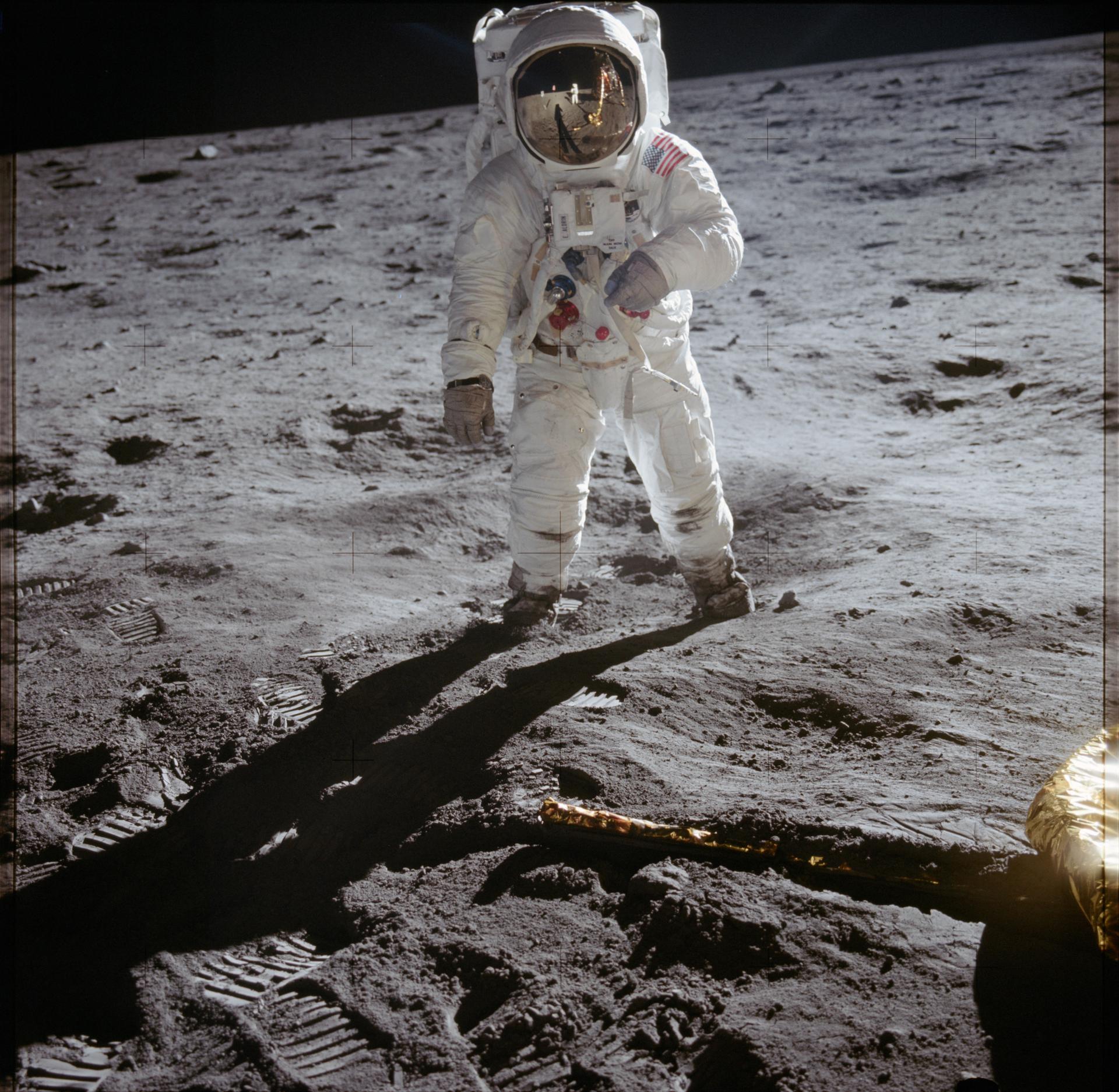
Apollo 11, 1969. Every word traveled home on Collins-built equipment. NASA, public domain.
|
| At the same time Arthur was chasing his most ambitious and ultimately most dangerous idea, a project called the C-System. It was meant to be an integrated computer and communication platform, and looking back at it now, it was essentially a prototype of the internet, built in the 1960s. It was brilliant. It was also financially catastrophic, and combined with the winding down of Vietnam spending and space program cuts, it drained the company at the worst possible time. In November 1971 the Rockwell board removed Arthur Collins from the company that bore his name. On December 7, 1971, he resigned. |
| Exile, and a Message Left in a Wall |
| Arthur did not fade quietly. He started Arthur A. Collins, Inc. in Dallas, filing patents and finding few buyers. He took his son Mike fishing on the Mississippi near Guttenberg, Iowa, and when the fish were not biting he would simply buy some, what his son remembered him calling replacement fish. He encouraged his son David’s art career even though he called it a tough way to make a living, and by most accounts he carried some regret over how little time the company had left him for his own children. |
| He was also, by nature, almost pathologically private. He reportedly turned down an interview request from Walter Cronkite, at the time the most trusted man in America, because he considered his life a private affair. Almost no recordings of his voice survive. One of the only known examples is a 1960 testimonial speech for fellow ham John Reinartz, not discovered publicly until years later. |
| Which is what makes one detail from 2018 hit as hard as it does. Construction workers remodeling the original 1942 Collins Radio building in Cedar Rapids tore into an old wall near the executive suites and found a brick signed by Arthur Collins and dated 1942, hidden for seventy six years. Family members later confirmed the signature was his. For a man who spent his whole life avoiding the spotlight, it is the one deliberate personal mark he is known to have left behind. |
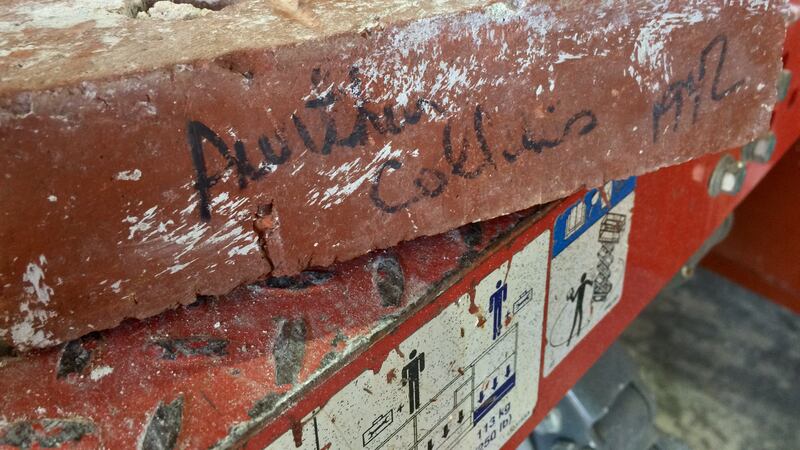
The brick Arthur Collins signed in 1942, found sealed in a wall in 2018. Credit: KCRG-TV9.
|
| Arthur Collins died on February 25, 1987, from complications of a stroke, at 77 years old. During his final three weeks in a Dallas hospital, paralyzed on one side and barely able to speak, he had a computer brought into his room so he could try to keep working. His last words to a colleague were, “There are still so many things I need to do.” He died the same week as Andy Warhol and David Susskind, and almost no media covered his passing, which is exactly how he would have wanted it. |
| Twenty Five Years Too Early |
| Here is the part that stays with me. The C-System that bankrupted him, the project that cost him his own company, was built on the same idea that became the internet, computers and communication merging into one network. He was not wrong. He was just about twenty five years early. Today the Collins name lives on through Rockwell Collins and now Collins Aerospace, part of RTX, and roughly 70 percent of United States military airborne communications still run through Collins descended systems. Collins avionics sit in the cockpit of nearly every commercial airliner flying today. |
| A teenager who beat the Navy at its own game. A company saved by a rocket scientist’s forgotten patent. A secret radio room that carried the country’s darkest hour. A voice from the Moon. And a private, difficult, brilliant man who spent his last conscious weeks still trying to build the future, even from a hospital bed. |
| From a cellar to the Moon. That is the Arthur Collins story, and now you know it. |
|
Director’s Cut
Want the deeper dive? This week’s audio Director’s Cut goes somewhere the article doesn’t, a four star general, a bootleg radio network, and a phone call that woke up an admiral at two in the morning.
Listen to the Director’s Cut |
| 73 de N2LEE |