
Field Day Weekend and the International Roots of the Tradition
This week’s issue is a timely update for Field Day weekend, with the deeper backstory linked below for readers who want the full history.

Every Friday, I try to bring you something current, useful, and worth reading before the weekend bands heat up.
This week, the timing lines up with Field Day weekend, so the issue opens with a fresh update and a quick backstory link for anyone who wants to go deeper.
The original history is still worth knowing, but this issue is about what matters right now.
The Name That Stopped Me
Most hams know Field Day as Field Day.
Simple. Familiar. Almost part of the furniture.
But the first ARRL announcement did not call it that.
In the June 1933 issue of QST, the event appeared under a much more revealing name:
June 10th – 11th, 1933
That one word matters.
International.
It was not decoration. It was not a little flourish from an enthusiastic editor. It was the clue that opened the whole story.
Because the first Field Day was not simply an American idea launched in isolation. The original documents connect it directly to a British event already underway across the Atlantic.
The first ARRL Field Day was officially called International Field Day.
And according to the June 1933 QST, it was an outgrowth of the Radio Society of Great Britain’s National Field Day.
The British Connection
Buried in the same June 1933 issue, the IARU News section explains the connection plainly.
The international field day scheduled for June 10th and 11th was described as an outgrowth of the national field day instituted by the R.S.G.B. for British Empire stations on those dates.
That means the Radio Society of Great Britain was not a footnote. It was part of the origin story.
Even better, the ARRL was not working in a vacuum. The same primary-source material points to planning and encouragement involving the A.R.R.L., the R.S.G.B. in Britain, N.V.I.R. in the Netherlands, and the Réseau Belge in Belgium.
Suddenly, the name International Field Day makes perfect sense.
The founders were not just asking American hams to haul equipment into the field.
They were trying to build something broader: a coordinated, international portable operating event.
Not Just a Contest
The original announcement did use the word contest.
That part is interesting, especially because today we often hear Field Day described as an operating event, not a contest.
But the 1933 text tells us what the contest was really for.
The announcement explained that the real object was to test portables wherever they might be available. Then it added a sentence that, in hindsight, is almost funny:
If successful we want to make it an annual affair.
More than ninety years later, that line deserves a slow nod from every club picnic table in America.
They did make it annual.
Then they made it legendary.
The Rules Reveal the Mission
When you look at the scoring, the purpose becomes even clearer.
The rules rewarded more than raw contact totals. They gave special value to portable and foreign contacts. Working stations in other countries could increase the score, and foreign country prefixes added to the multiplier.
That is not accidental.
The scoring system was trying to encourage exactly what the name promised: portable operating with an international complexion.
This was not simply, “How many people can you contact?”
It was closer to, “Can you set up away from home, make the station work, and reach beyond your own neighborhood?”
That is a very different kind of test.
I almost told this story the usual way: Field Day began as an American emergency preparedness exercise.
Then the original June 1933 QST forced me to slow down.
The founding language was more specific, more international, and frankly more interesting than the version many of us have repeated for years.
Where Emergency Preparedness Fits
None of this erases Field Day’s emergency communications heritage.
Far from it.
Field Day became one of amateur radio’s great annual demonstrations of operating under less-than-perfect conditions. Generators. Batteries. Temporary antennas. Improvised stations. Operators learning how to make things work when the shack is no longer the shack.
That lesson is real.
But the original 1933 announcement framed the event more narrowly as a test of portable stations in the field. The broader emergency-preparedness identity grew stronger as the event evolved.
That distinction matters.
It lets the founders speak in their own words instead of forcing modern language backward onto them.
Why This Discovery Matters
This is why original sources are so valuable.
If we only read modern summaries, we get the clean version. Field Day began in 1933. It tested emergency communications. It became an annual tradition.
All of that is useful.
But it misses the spark.
The first Field Day was born in a moment when amateur radio organizations on both sides of the Atlantic were thinking about portable stations, field operation, and international contact. The ARRL did not merely create a domestic tradition. It joined and expanded a larger idea.
That is a much better story.
The Rest of the Story
So the next time someone asks what Field Day is, you can still say it is a contest, an operating event, an emergency exercise, a club gathering, a public demonstration, and a yearly excuse to find out which generator refuses to start.
All of that is true.
But now you know something deeper.
The first Field Day carried an international name because it had international roots.
It was connected to Britain’s National Field Day, encouraged by organizations across Europe and North America, and designed to see whether portable amateur stations could actually do the job.
Not from the comfort of the home shack.
From the field.
And that is the part that still echoes every June.
A wire in a tree. A radio on a folding table. A call into the noise.
More than ninety years later, we are still answering.
The key source for this article is the June 1933 issue of QST, where the event appears as International Field Day and is tied directly to the R.S.G.B. National Field Day.
This Weekend on the Bands
ARRL Field Day note: This weekend is also ARRL Field Day, which we covered in a previous issue. If you want the backstory, read The ARRL Field Day History I bet you didn’t know!.

Plain-English takeaway: The bands should be usable, but keep your expectations flexible. Current SWPC guidance suggests a fairly workable weekend with some geomagnetic wobble, so the upper HF bands may open and close in short bursts rather than staying wide open.
- Best bets: Start with 20 meters for the safest daytime choice. Check 17 and 15 meters if the sun is doing its job, then move to 40 meters after sunset.
- Could be rough: 10 and 12 meters may only pop open briefly. If the geomagnetic field gets unsettled, higher bands and polar paths can get noisy or unpredictable.
- Try this: Do not write off a band too quickly. Recheck the upper bands later in the day, and keep 20 or 40 meters ready as your fallback plan.
- Watch for: Flare activity can still produce short radio blackout moments. If signals suddenly fade, it may be the Sun and not your station.
Based on current NOAA / SWPC forecast guidance and ham-band operating indicators checked June 26, 2026.
This Week’s New-Ham Snapshot
Plain-English takeaway: The latest FCC snapshot now shows 11,396 new individual amateur licenses issued in 2026 so far.

11,396
New individual licenses
+366
Mostly first week of June
That keeps the weekly licensing picture simple: the hobby is still bringing in new operators, and the growth curve remains healthy.
Source: FCC ULS license data · New individual amateur licenses issued monthly · Updated weekly by HRG
HRG Blue Book Signal
As of June 5, 2026 · Pricing based on monitoring dozens of sites
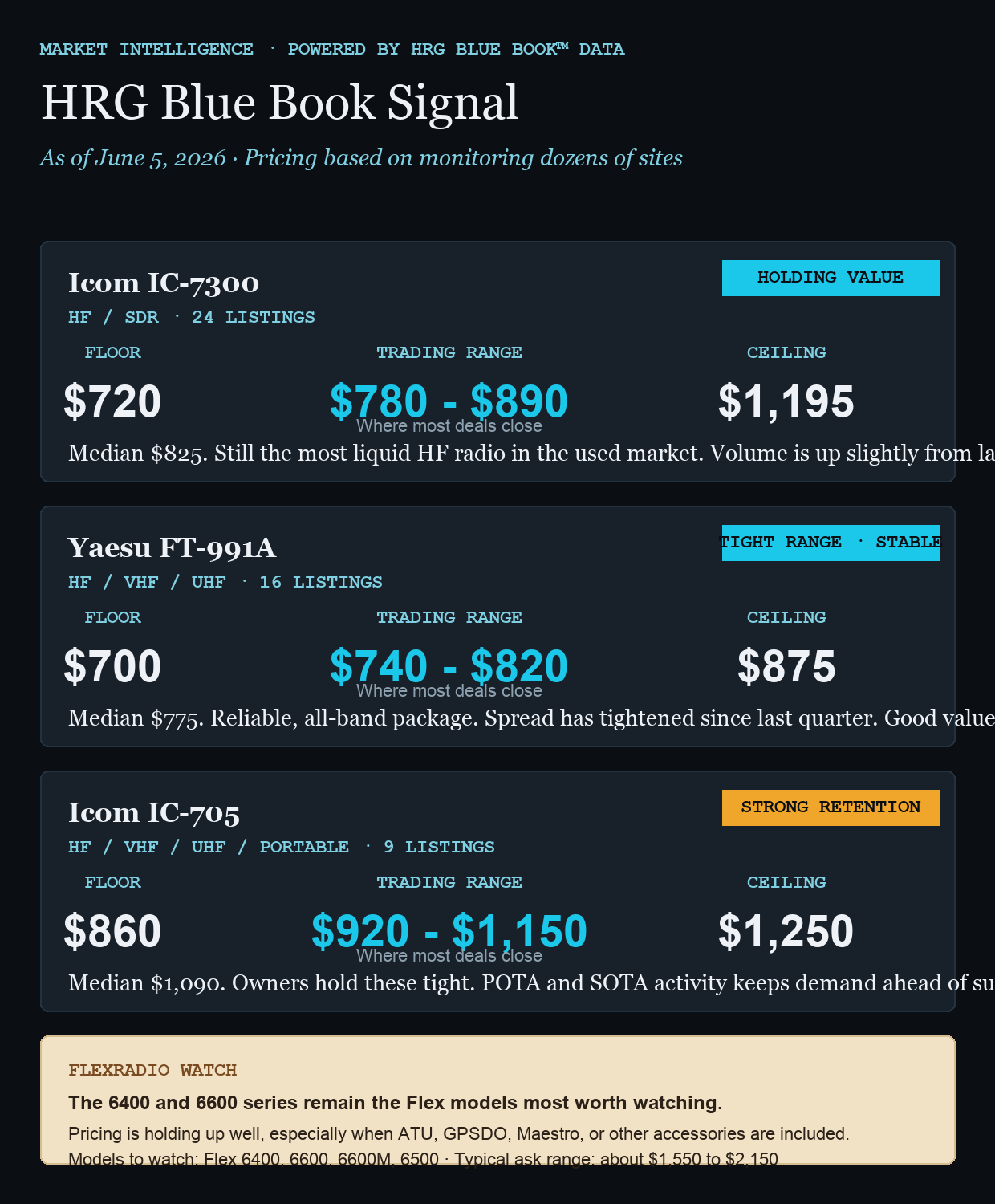
Icom IC-7300
HF / SDR · 24 listings
Median $825. Still the most liquid HF radio in the used market. Volume is up slightly from last issue. Floor units move within 48 hours. If you see one clean under $750, it sells fast.
Yaesu FT-991A
HF / VHF / UHF · 16 listings
Median $775. Reliable, all-band package. Spread has tightened since last quarter. Good value for a first HF rig with no upsell needed.
Icom IC-705
HF / VHF / UHF / Portable · 9 listings
Median $1,090. Owners hold these tight. POTA and SOTA activity keeps demand ahead of supply. When one shows up clean, it goes fast.
The 6400 and 6600 series remain the Flex models most worth watching.
Pricing is holding up well, especially when ATU, GPSDO, Maestro, or other accessories are included.
- Models to watch: Flex 6400, 6600, 6600M, 6500
- Typical ask range: about $1,550 to $2,150
- Buyer note: Compare complete setups, not bare radio bodies
Source: HRG Blue Book marketplace tracking.
Next Week in Ham Radio Wayback
Next week, we keep digging into the stories behind the gear, people, companies, and communications ideas that shaped amateur radio. Every Friday, something I bet you didn’t know.
Sources
- QST, June 1933, Vol. XVII, No. 6: original International Field Day announcement and IARU News item.
- June 1933 QST scan at World Radio History
- ARRL Field Day history references and contest archive material.
- Uploaded Field Day origin verification report and primary-source notes.
- NOAA / Space Weather Prediction Center forecast products.
- HRG Blue Book marketplace tracking.
- HamRadioWayback.com main page and newsletter signup
S
S